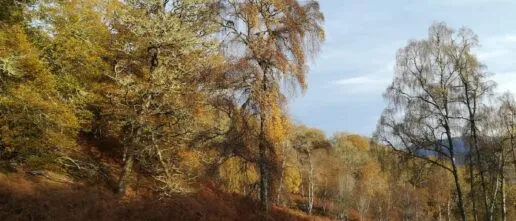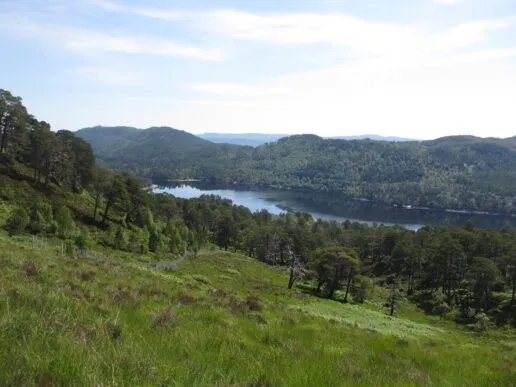
Forest expansion is an increasing UK priority and Scotland, which was historically extensively forested, receives a significant proportion of this. Mature forest remnants in the Scottish Highlands support rare specialist species and many have been continuously forested for millennia. However, current policies and grants incentivise forest creation by planting, leading to underinvestment in protection of and expansion from forest remnants. Using a combination of designed experiments and data collection across natural gradients, this project will explore aboveground processes of forest establishment, interactions with belowground communities and soil properties, and ecosystem function and biodiversity responses to forest expansion by natural regeneration and planting.
In collaboration with Trees for Life, we collected data on soil communities and properties across a landscape-scale network of plots within Trees for Life’s Wild Trees Survey in the summer of 2024, funded by a John Fell Fund grant. Trees for Life’s pioneering work provides detailed information on the status of mature forest remnants across Scotland and the dynamics of natural tree regeneration within and around these remnants. We are linking data on tree regeneration and forest status to a set of variables on soil communities, soil physical properties, and soil chemical properties. Initial results suggest that early establishment of naturally regenerating trees is not linked to soil carbon status. Soil communities both facilitate tree establishment and respond to the establishment of trees, and we will use a fungal dataset collected simultaneously to explore whether fungal communities drive tree establishment and explain differences in soil physical and chemical properties.
Data collection across the natural gradient of forest status represented by Trees for Life’s network of survey plots is complemented by experimental work in collaboration with Highlands Rewilding. We have co-designed an experiment exploring mechanisms of forest establishment and soil property/community responses. The experiment considers natural regeneration and tree planting with and without mycorrhizal inoculation as mechanisms of native forest creation in a clear-fell plantation. We collected a tree height baseline at the site after the first growing season in 2024 and will return in autumn 2025 to assess differences in tree growth and establishment across the treatments.
Native forest restoration is a key conservation activity in the Scottish Highlands, expanding from forest fragments that have shrunk to c.1% of their former range. In summer 2025 we began a project using passive acoustic monitoring to explore bird, bat, and invertebrate biodiversity in remnant Caledonian pinewood, comparing this to regenerating pinewood and unforested heathland nearby. This project will assess the biodiversity value of restoring remnant forest and also trial a novel method of assessing invertebrates in these environments.
Partners