Nature’s benefits refer to the advantages that humans derive from the natural environment. While the concept is rooted in conservation and ecology, it is also widely applied in planning, government, business, and economic decision-making. Despite its broad relevance, assessing nature’s benefits presents significant challenges. These include difficulties in carrying out assessments and in translating findings into practice, alongside persistent gaps in data across spatial scales and subject areas, and issues related to data accessibility and usability.
In response to these challenges, alternative approaches to collecting and sharing data on nature’s benefits have been proposed. One such approach is community science, which involves volunteers participating in scientific research processes. However, to date, no study has examined the relationship between community science and nature’s benefits assessment at a national policy scale.
Our article, “Community (citizen) science for assessing nature’s benefits: a systematic review and survey” was recently published in the British Ecological Society journal People and Nature, investigating this exact topic. Our study explored how existing community science initiatives in the UK could support, or contribute to, assessments of nature’s benefits, as defined by the UK’s Enabling a Natural Capital Approach guidance.
We employed a mixed-methods approach, beginning with a systematic review of community science hubs and two scientific databases. Findings from this review then informed the design of a national survey distributed to community scientists across the UK, which explored their experiences with, and perceptions of, participating in community science related to nature’s benefits.
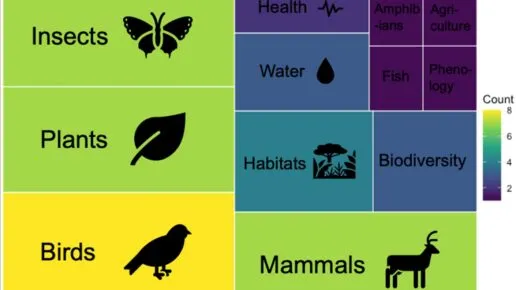
The systematic review echoed findings from previous studies, showing that biodiversity-related data—particularly on birds—are the most common focus of community science initiatives and have been collected over the longest period time in UK community science. Nature’s benefits associated with vegetation also appeared frequently in community science projects. In contrast, benefits related to soils, minerals, water, and cultural ecosystem services, such as recreation, were far less represented in the literature. Interestingly, these patterns differed from survey responses, where community scientists reported greater involvement in community science activities linked to cultural benefits, such as education, as well as water-related benefits.
Then the survey examined whether participants supported the use of community science to assess nature’s benefits. All respondents indicated that they either supported this or maybe supported this. Moreover, community scientists raised concerns were raised around data quality, alongside a strong emphasis on the importance of monitoring nature’s benefits using multiple data sources rather than relying solely on volunteer-generated data.
Overall, our findings suggest that community science has considerable potential assess nature’s benefits but to do so current community science should be expanded to cover underrepresented nature’s benefits, particularly those related to soils and cultural services. Notably, current UK guidance on nature’s benefits does not explicitly promote the use of community science data. If community science is to play a more substantial role in assessing nature’s benefits, clearer guidance, increased funding, and stronger institutional support will be essential to enable its effective integration into national assessment frameworks.
* This research originated from my master’s studies at the University of Oxford’s School of Geography and the Environment, undertaken as part of the MSc in Biodiversity, Conservation and Management, now known as Biodiversity, Conservation Management and Nature Recovery. It was funded by Rotary International and the Rotary Club of Cleveland, Ohio.