
Why we are developing a future strategy
As the Centre looks ahead to its next phase, we need to evolve not only the research we conduct, but also the tools, techniques and methodologies we use, and crucially, the way we organise ourselves to support that work.
We want to produce ground-breaking research that brings together researchers, disciplines and different ways of understanding nature recovery to tackle some of the complex, “wicked” problems that cannot be addressed by any one field alone.
We have achieved a great deal during our first five years, building strong expertise, partnerships and a diverse research community. But we also know that collaborating across departments, disciplines, timescales and academic backgrounds is difficult within university structures that are often organised around individual subjects.
With this in mind, we brought together the collective experience and perspectives of our researchers, partners and senior leaders to ask where we could make the greatest contribution over the next five years. We wanted to identify a small number of cross-cutting questions that could bring people together around shared challenges, encourage genuinely interdisciplinary research and help us make a tangible contribution to nature recovery.
The result is a strategy designed to make the Centre more interdisciplinary by design while allowing us to build on existing strengths, knowledge and expertise.
Our research priorities for the next five years
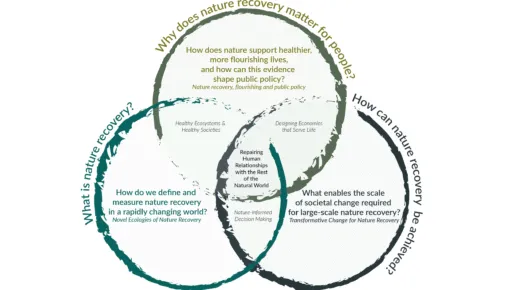
Our future research will be organised around three connected questions. Together, they ask what nature recovery is, why it matters for people, and what it takes to achieve it at scale.
These questions are deliberately broad enough to bring together different disciplines and approaches, but focused enough to support ambitious research over the next five years. They are not intended to create new silos: researchers may contribute to one or several questions, and we expect connections between them to generate new ideas and collaborations.
What is nature recovery?
Novel Ecologies of Nature Recovery
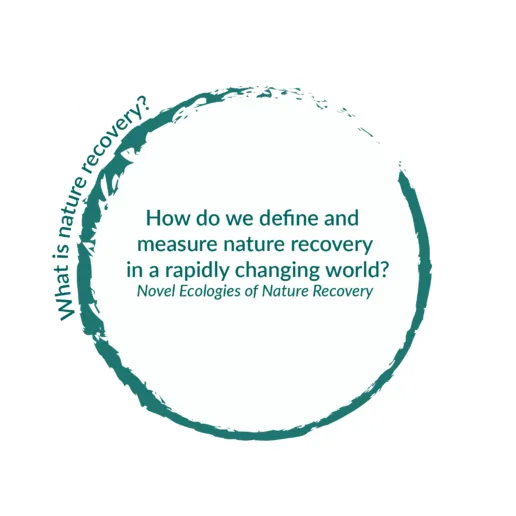
How do we define and measure nature recovery in a rapidly changing world?
Nature recovery has become a global priority, but there is still limited agreement about what a recovering ecosystem looks like or how recovery should be measured. Traditional approaches have often focused on species, habitats, abundance or comparisons with historical baselines. These remain important, but they may not capture the full picture of recovery in a rapidly changing world.
We want to explore broader ways of understanding and measuring recovery, including ecosystem function, ecological processes, connectivity, resilience, soils and energy flows. This includes understanding recovery across wild, agricultural, urban, rewilded and other novel ecosystems, and how climate change is changing the conditions in which ecosystems recover.
Nature recovery is also shaped by people and their relationships with the living world. Different communities and cultures may have different views about what should be recovered, what a healthy environment looks like, and who should have a say. We therefore want to bring ecological, social, cultural and other forms of knowledge together to understand the different ways nature recovery is defined, valued and contested.
Research in this area could include new approaches to measuring ecological function and resilience, understanding recovery in different types of ecosystem, integrating different forms of knowledge, and exploring how values, livelihoods and governance shape decisions about nature recovery.
Why does nature recovery matter for people?
Nature Recovery, Flourishing and Public Policy
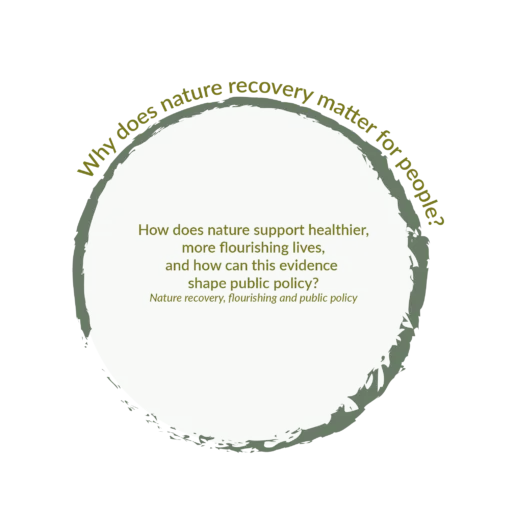
How does nature support healthier, more flourishing lives, and how can this evidence shape public policy?
There is strong evidence linking nature with human health and wellbeing, but we know much less about the mechanisms through which these benefits arise and how they vary between people and places. We want to understand how contact with nature, the quality of nature and nature recovery influence physical health, mental health, social wellbeing and longer-term human flourishing.
We are particularly interested in moving beyond broad associations to understand the conditions and mechanisms that matter. This includes asking how ecological quality, access to nature and people’s experience of nature affect outcomes, and how these relationships differ across populations and contexts.
A key part of this work is translating evidence into public policy and practice. We want to explore how the health, economic and wider societal benefits of nature can inform policy and investment, while ensuring that approaches designed to benefit people also support biodiversity, ecosystem function and ecological recovery.
Research in this area could include work on the links between ecological condition and health, nature contact and longer-term flourishing, the distribution of benefits and inequalities in access to nature, valuation and health economics, and the design of policies that support both human and ecological wellbeing.
How can nature recovery be achieved?
Transformative Change for Nature Recovery
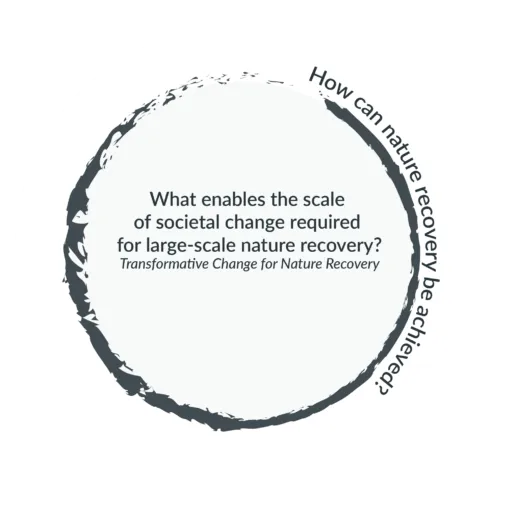
What enables the scale of societal change required for large-scale nature recovery?
There is increasing clarity about the scale of change needed to put nature on a path to recovery, but much less understanding of how that change happens in practice. We want to understand how governments, institutions, economies, communities and individuals move from current systems towards more sustainable and nature-positive ones.
This means looking beyond incremental change to the underlying structures, incentives, institutions and relationships that shape decisions. We are interested in why change succeeds or stalls, how resistance and vested interests operate, and how approaches that work in one place or sector can be adapted, connected and scaled.
The work will also examine the conditions needed for change to be just, inclusive and accountable. Questions of power, wealth, governance and whose knowledge is recognised are central to understanding why some approaches succeed while others do not.
Research in this area could include work on institutional and political barriers, economic and financial systems, governance across different scales, regulation and incentives, the role of organisations and communities, pathways to scale, and real-world examples of successful or unsuccessful transformation.
A framework for research, collaboration and new ideas
We believe these questions are broad enough to create entry points for both existing and new research. We will continue to support in-depth research across a wide range of subjects related to nature recovery, while using these three questions to guide our collective work over the next five years.
We also want the Centre to be a place where ideas come together. We will create opportunities for researchers, partners and practitioners to connect through events, workshops, debates and other spaces for discussion around these questions.
As we recruit new researchers, we will be looking not only for people who can produce excellent research, but for people who can help build connections, bring different perspectives together and contribute to wider communities of research and practice.
Our ambition is to create the space for deep thinking, productive challenge and new collaboration and to turn understands empowers and enables what it takes to enable life on earth to thrive by repairing human relationships with the rest of the natural world.
