Rewilding is a powerful conservation ideas that portrays a hopeful vision for restoring dynamic ecosystems, reintroducing lost species, and letting nature lead. But as rewilding projects rapidly expand across the UK, an important question we should be asking is: who gets to define what rewilded nature looks like?
And increasingly, part of the answer may be: AI.
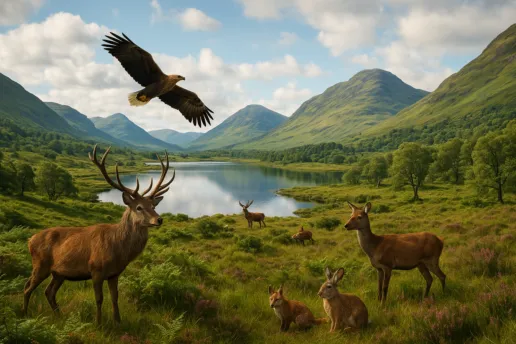
In our new study, we analysed 4,667 images from nine UK rewilding organisation websites alongside AI-generated representations of rewilding produced by chatbots. What we found is that both tell a similar story.
A sanitised vision of nature
Across organisational websites and AI outputs alike, rewilding imagery focuses on charismatic species including red squirrels, beavers, and butterflies, as well as scenic landscapes. What is largely absent is the messier reality of ecological recovery such as scrubby vegetation, death and decay of carcasses left in place, reptiles and amphibians, all part of the less conventionally photogenic work of restoration.
Empty landscapes, missing people
Perhaps most striking is who is absent from these images. Rewilded landscapes are consistently portrayed as devoid of permanent human presence, very few residents, people working the land, or infrastructure in sight. When people do appear, they are recreationists or volunteers passing through, not people who live and work in these places. These are not neutral aesthetic choices. They quietly normalise a vision of rewilded futures where certain people, and certain ways of relating to land, do not belong.
Why AI changes the stakes
This has always been a concern in conservation communications (see Wartmann & Lorimer 2024). But the rise of AI-generated imagery makes it considerably more urgent. AI systems are trained on existing visual and textual content, meaning today’s exclusionary representations are actively shaping the outputs of tomorrow’s AI tools. When AI chatbots generate images of rewilding and reproduce the same charismatic species, empty landscapes, and sanitised aesthetics, it risks locking in these biases at scale.
There is, however, a more hopeful implication. If conservation organisations diversify their visual communications now, and making space for messy ecologies, non-charismatic species, and the full diversity of people who live alongside nature, they are not only acting for immediate social justice reasons. They may also be shaping how future AI systems learn to represent nature recovery, potentially creating a positive feedback loop toward more inclusive environmental imaginaries.
What this means for practice
Rewilding holds genuine promise for addressing biodiversity loss and climate change. But the futures it builds toward will be shaped not only by ecological interventions, but by the stories and images we use to communicate them. If we want rewilding to be socially just and inclusive of a diversity of people, species and ecological processes, our visual representations need to catch up with that ambition.
Related Research Themes

Society
Encompassing the governance and socio-cultural dimensions of nature recovery.

