Sophus zu Ermgassen and Alice Stuart explain all you need to know
In my last 10 yrs in biodiversity finance I’ve seen tens of reports that say stuff about the total amount of finance flowing into nature or speculate on the total funding gap or funding needs. I’ve often found it a bit mind-blowing that people can say that stuff with confidence because the nature finance I know is horribly untransparent. Stuff people say in public is often unverifiable and also there’s no consensus about what nature finance actually means. Do a water company’s green bonds for improving water treatment infrastructure count? Do public stocks with a good ESG score count? A lot of people include stuff that’s not within a definition that a nature conservationist would recognise.
So Dr Alice Stuart (supported by me, The Leverhulme Centre for Nature Recovery and Circular Bioeconomy Alliance) thought we’d give it a go – to trawl through the public information to assess what verifiable nature finance into species and ecosystem conservation is flowing in a given region (UK). Our new paper in Ambio: “Generating a national snapshot of all publicly reported investments in ecosystem and species conservation across public, private, and philanthropic finance“, tracking all the investment that we could find in the public domain in the UK from around 2023/2024.
My takeaways: – we estimated £1.15 billion/year of publicly-reported nature investment.
- We can’t trust a lot of stuff people say about the amount of nature finance flowing into nature because data availability is super sketchy. Superficial assessments just aren’t going to be trustworthy.
- Alice found that as of 2024 the dominant nature finance was public subsidies, grants programmes, and corporate philanthropy. It’s interesting that at the time, even though there were multiple nature markets working in England, corporate philanthropy still dwarfed these. I expect the picture has changed a little bit as BNG investment has risen since then but it shows that philanthropy is still totally comparable with nature markets. Our paper also provides a really useful baseline for somebody to repeat in a couple of years’ time to see how the overall picture has changed, including changes in private investment.
- There’s no information at all in public about some really important aspects of nature investment, such as the operational investment of large land managers, which we know is critical.
- Double counting is an issue. eg When a financial institution makes an investment in BNG units what counts: the investment or the fundamental sale of those units, given that a big chunk of that investment is paying investors back and not delivering nature recovery?
- Ultimately what Alice and I are particularly interested in is not the amount of finance flowing but the actual outcomes it delivers. Feels like we’re still miles away from getting to that point.
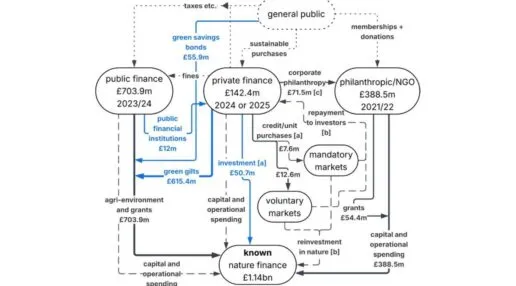
Nature finance flows
Flowchart showing the nature finance flows for which we were able to find a minimum estimate (solid arrows) for nature finance flows in the UK found within this rapid review. Known flows that we were unable to find data for are shown with dashed arrows. Dotted lines (i.e. corporate fines and flows from the general public) represent flows we did not include in this analysis but have included in the figure for context. Black arrows represent non-return-seeking funding, and blue arrows represent return-seeking finance. All return-seeking finance has been counted in the recipient (as opposed to the loaner’s or investor’s) category to avoid double counting. [a] £35m of the private investment found was an investment by Gresham House in 2023 into the Environment Bank, which creates and sells biodiversity units in England domestic biodiversity market ‘biodiversity net gain’. In this way there will inherently be double counting between private investment and credit/unit purchases. [b] Note the two sets of arrows representing flows from markets, demonstrating that revenues may be used to pay back investors, as well as put into further nature restoration (reinvestment in nature), as such we have not included market transactions in our overall estimate of nature finance (although their impact would be small, increasing the overall estimate to £1.16bn). [c] Corporate philanthropy flows found predominantly consist of £70.9m of charitable payments by Aviva to the Wildfowl & Wetlands Trust, Woodland Trust, Wildlife Trusts, and WWF UK, all of which are included in the capital and operational spending estimate for philanthropic/NGO flows; thus, this has not been considered additional in calculating final known nature finance value.
Related Research Themes

Finance
Scaling finance and investment for rapid nature recovery at a global scale.

Systems
Developing a novel Analysis and Decision Platform to integrate nature recovery into land-use and infrastructure planning, and exploring scenarios that can deliver local, national and international commitments to nature, climate change and sustainable development.