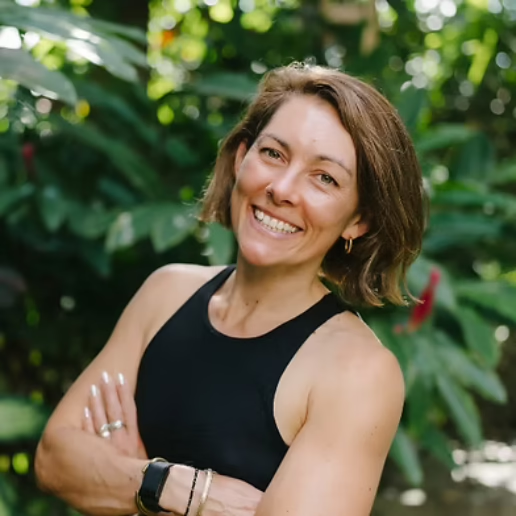
Indonesia is home to globally important populations of critically endangered sharks and rays, yet these species are frequently caught by small-scale fishers whose livelihoods depend on marine resources. Dr Hollie Booth’s work has shown that conservation policies are most effective when they are developed alongside the communities they affect.
Since 2021, her research has shaped fisheries and conservation policy at multiple levels across Indonesia. She implemented the world’s first randomised controlled trial of marine conservation incentives, informing revised customary laws and marine protected area management plans for hammerhead sharks and wedgefish in Aceh Province. She also led Indonesia’s first vessel buyout pilot programme for shark conservation in West Nusa Tenggara Province, supporting fisheries management and implementation of Indonesia’s international conservation commitments.
By combining rigorous evidence with community participation and engagement across government, her approach offers a practical model for delivering positive outcomes for both marine biodiversity and coastal communities.
Professor Martin Maiden, Head of the Department of Biology, said:
‘The department is delighted to congratulate Hollie on receiving the MPLS Social Impact Award. A former DPhil student, Hollie’s career has blossomed to demonstrate how world-leading research can deliver tangible benefits for both people and nature. Her innovative work in Indonesia has combined rigorous scientific evidence, including the world’s first randomised controlled trial of marine conservation incentives, with deep engagement of local communities, NGOs and policymakers.
‘By developing and testing practical, equitable approaches to shark and ray conservation, Hollie’s research has influenced fisheries and conservation policy across Indonesia, while supporting the livelihoods and wellbeing of coastal communities. Her work exemplifies the Department’s commitment to interdisciplinary, evidence-based research that matters to global challenges and creates meaningful societal impact. We are immensely proud of her achievements and delighted to see them recognised in this way.’
