Across environmental research and policy, powerful new technologies from satellites and LiDAR to AI, drones and sensors are transforming what we can measure about the natural world. They have made enormous contributions to our understanding of biodiversity loss and climate change, and they underpin ambitious international goals. But these same technologies can also create distance: between the people doing the seeing and the people and places being seen.
This is one of the central questions explored in our new paper, Reversing the gaze on nature in an era of technological innovation, and in a recent workshop led by Constance McDermott and I at the Oxford Martin School. Together, the paper and workshop ask a simple but far-reaching question: what would it mean to reverse the gaze on nature recovery?
The phrase speaks to a long-standing concern in environmental governance. Much of the dominant “view” of nature today is a view from above: remote, standardised and data-rich. Donna Haraway famously described this as the “god trick”: the illusion of seeing everything from nowhere. In conservation and restoration, that gaze can be useful. But when it becomes the sole or default view, it risks narrowing our understanding of what counts as knowledge, what counts as action, and whose relationships with nature are made visible.
Distance is not only vertical. It can also arise when research privileges abstraction over lived experience, numbers over meaning, and technological fluency over multi-sensory, embodied and place-based ways of knowing. Over-reliance on data-driven approaches can flatten the complexity of human–nature relations, making it harder to recognise the everyday forms of care, stewardship and accountability that often sustain recovery on the ground. The preprint argues that many such contributions remain invisible to target-led governance, even when they are critical to long-term ecological resilience and justice.
A reversed gaze begins from a different premise: that there is more to see, and more ways to see it.
A reversed gaze asks what happens when we shift both perspective and power. What happens when technologies are designed not simply to survey landscapes from afar, but to illuminate how nature is experienced in place? What happens when they support plural, grounded and equitable forms of knowledge? And what might change when targets and interventions emerge from multiple perspectives, rather than only from above? These are the core questions at the heart of the preprint, which uses the Kunming-Montreal Global Biodiversity Framework as a case to explore how global targets might be widened (but not abandoned) to better recognise diverse forms of care for nature.
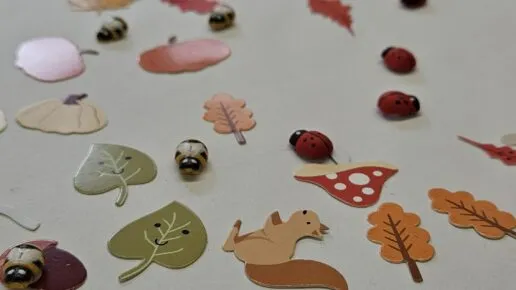
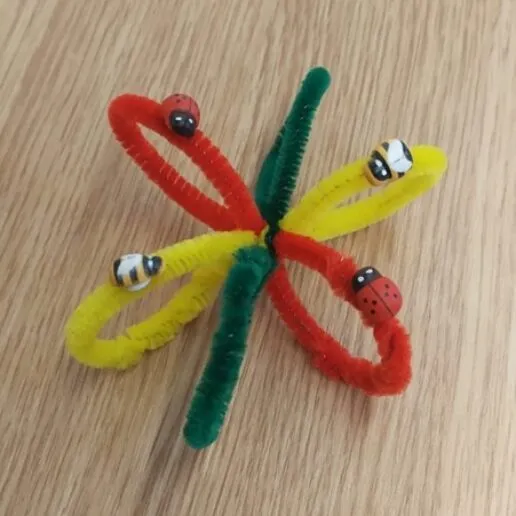
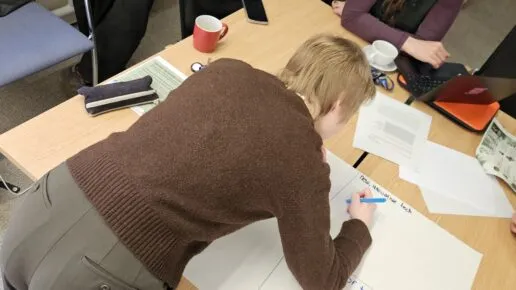
At our 5th of March workshop, these ideas were explored in practice through discussion, art-based methods and speculative design. Participants were invited to imagine what a reversed-gaze study might look like and to “hack” technologies accordingly. The aim was not to reject digital tools, but to rethink how they are used, by whom, and for what purposes. The result was a series of inventive sketches that made visible new scales, new perspectives and new possibilities for nature recovery research.
.
Among the ideas generated were a LiDAR headset revealing ecosystem structure from the perspective of a playing child; a rolling biodiversity lab tracking insects, plants and pollination interactions; a leaf-litter rover exploring community gardens as sites of hidden urban biodiversity; and a “curiosity camera trap” using a bee lure to monitor populations of nature-watchers. Playful as they were, these concepts also made a serious point: technologies are never neutral. They frame attention and shape what becomes legible. Technologies can be repurposed to foreground curiosity, care, reciprocity, and local knowledge rather than only efficiency, standardisation, and surveillance.
This matters because nature recovery is not just a technical challenge. It is also a question of values, relationships and governance. Our work argues that if environmental targets are to support genuinely transformative change, then the ways we measure progress must become more open to plural ways of knowing and to the situated realities of particular places. It also stresses that greater visibility is not automatically good: making local practices legible to powerful institutions can carry political risks, including appropriation or erasure. For that reason, any reversed gaze must be grounded in co-design, epistemic justice and careful attention to who benefits from being seen.
For the Leverhulme Centre for Nature Recovery, these questions go to the heart of what nature recovery should be. Recovery will not be fairer or more effective simply by producing more data. It will depend on whether we can build forms of knowledge and governance that recognise the diversity of human–nature relations already sustaining life in particular places, and whether technology can help support that work without overriding it.
Reversing the gaze is therefore not about turning away from innovation. It is about asking more searching questions of it. What kinds of worlds do our tools make visible? What do they leave out? And how might they be redesigned to support more just, plural and grounded pathways to recovery?
We would love to hear how others are thinking about perspective, scale and power in environmental research and what a reversed gaze might make possible in your own work, please do reach out by email or on some of our LinkedIn posts.