People and Nature (2026)
We found that when local communities take control of information about their land, they feel more empowered to protect the environment. Instead of relying on complicated digital tools owned by big companies, people are using their own local knowledge and creative mapping to make better decisions for nature.
Today, decisions about how to restore our landscapes depend heavily on huge amounts of digital data. However, this information is often hard to find, difficult to understand, or expensive to access. This creates a power gap where local people are left out of big decisions about the land on which they live. In some cases, having more data can even make things worse if private interests use it to exploit the land rather than protect it.
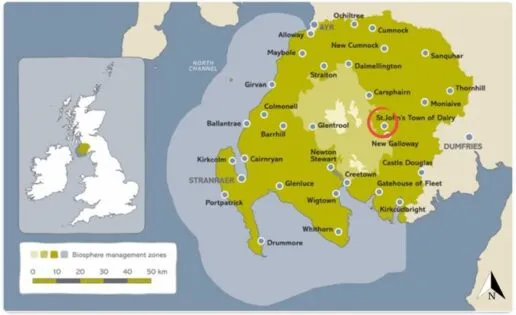
We wanted to see if giving communities better access to data could help them understand and support nature recovery. To find out, we spoke with and surveyed a wide range of people living and working in the Galloway and Southern Ayrshire UNESCO Biosphere in Scotland.
Our research shows that when people feel they don’t have the facts, it leads to conflict and frustration. In response, many communities are starting to create and manage their own data. They aren’t just using computer spreadsheets; they are using creative ways to show what they value. This includes mapping “desire lines”—the unofficial paths that people and animals naturally create through the woods or hills—and highlighting the specific views and places they treasure most.
We found that this community-led approach leads to much better engagement with nature recovery. People feel more connected to the process when their own knowledge is valued alongside satellite maps or official statistics.
We conclude that information about nature should be treated as a “common good”—something that belongs to everyone and is shared fairly. If we want to successfully tackle the climate and nature crisis, we must move away from private, top-down data and start supporting the people who know their landscapes best.
Related News Articles
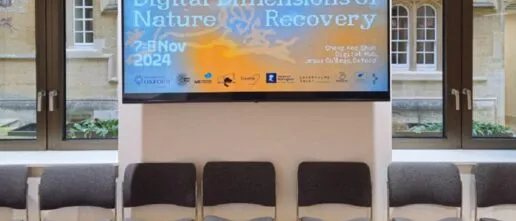
Beyond ‘technical fixes’: Digital Dimensions of Nature Recovery conference provokes debate at the interface between theory and application
Noemi Duroux, Lotti Jones, Caitlin Hafferty, and Jonathon Turnbull reflect on the 2024 Digital Dimensions of Nature Recovery conference,

Digital Dimensions of Nature Recovery conference explores the potential, pitfalls, and diverse futures of technological innovation
Noemi Duroux, Lotti Jones, Caitlin Hafferty, and Jonathon Turnbull reflect on the 2024 Digital Dimensions of Nature Recovery conference, which created a vibrant, interdisciplinary space for knowledge sharing and debate across science, policy, and practice.
Digital Dimensions of Nature Recovery
The first three papers arising from our Digital Dimensions of Nature Recovery conference have just been published
Related Research Themes

Society
Encompassing the governance and socio-cultural dimensions of nature recovery.
