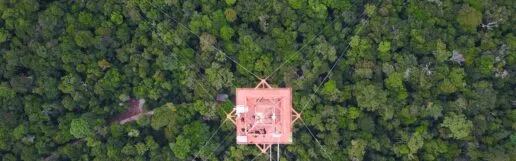
The atmosphere and rainforests form a tightly coupled system; incoming radiation and precipitation influence ecology, whilst transpiration and biotic aerosols (small particles suspended in the atmosphere) influence the atmosphere. Over the Amazon, especially during the wet season, the aerosol load is dominated by Secondary Organic Aerosols (SOAs); formed by the condensation and growth of Biogenic Volatile Organic Compounds (BVOCs), which trees produce to ameliorate stress and signal to other trees. This project aims to determine whether the eco-evolutionary and atmospheric effects of BVOCs are linked.
First, atmospheric modelling will be used to determine how SOAs influence the Amazonian atmosphere, and whether they make it more optimal for the rainforest. Secondly, an eco-evolutionary model will be developed to examine the conditions under trees evolve to collectively emit BVOCs to make the atmosphere more optimal for themselves. Finally, a hyperspectral drone will be used alongside measurements taken at the Amazon Tall Tower Observatory, and by the satellite EarthCARE, to measure how canopy-level hyperspectral traits, BVOC production, and cloud formation interact. This study will improve our understanding of how changes in forests may reshape the atmosphere (and vice-versa) as climate change intensifies, enabling e.g. the use of forest management for ‘bio-geoengineering’.
Supervised by Yadvinder Malhi (School of Geography and the Environment), Philip Stier (Atmospheric, Oceanic and Planetary Physics), and Stuart West (Department of Biology).
Related Research Themes

Ecology
Testing the effectiveness of different ecological approaches for nature recovery to support biodiversity and the delivery of ecosystem services such as climate change mitigation and adaptation.

Systems
Developing a novel Analysis and Decision Platform to integrate nature recovery into land-use and infrastructure planning, and exploring scenarios that can deliver local, national and international commitments to nature, climate change and sustainable development.
