Exploring the lived experiences and wellbeing benefits of everyday urban nature in Kumasi
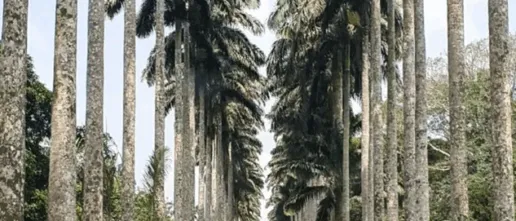
Over the last two years I have been working on a project to understand how communities across cities in Ghana value, and potentially benefit, from having access to urban nature. Within this project I was fortunate enough to visit different communities across Kumasi, the second largest city in Ghana, and a city historically known as the ‘Garden City of West Africa’. Now while the title was given due to the urban planning model developed by the British during the colonial period to manage urban sprawl, create ‘British’ lawns, and separate settlers from indigenous communities, the title remains at the forefront of the imaginations of residents today – albeit the amount of natural landcover in the city has dramatically reduced. During my time in Kumasi, alongside the fantastic research assistants Vincent Yaw Nkrumah Eloh and Vincent Adjei, we undertook participatory mapping exercises to identify ‘hotspots’ of value or importance, and photovoice interviews where individuals took images of areas of urban nature which were perceived to be beneficial, or detrimental, to their wellbeing.
The photovoice exercise in particular was hugely rewarding, allowing us as researchers to access lived experiences with ‘everyday’ nature, otherwise unobtainable through approaches which rely on remote sensing data to capture nature exposure or coverage. We were able to identify multiple short-term and long-term wellbeing responses that simultaneously arose from interactions and engagement with urban nature, expanding beyond the common focus on mental restoration and happiness within Global North studies. For example, the presence of urban agriculture within the homestead not only provided immediate satisfaction through consumption, but also fostered a sense of autonomy from not having to rely on market purchases, supported the preservation of traditional knowledge, and reminded respondents of their rural origins, providing continuity for their identity and a sense of attachment to their home and family.
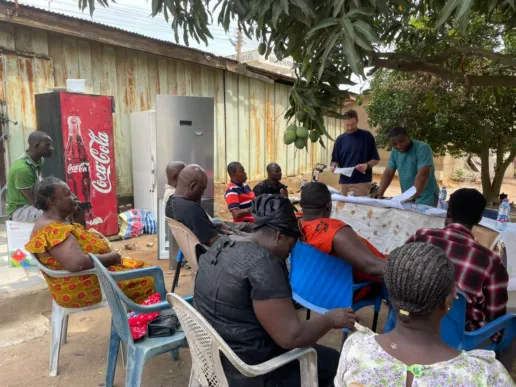
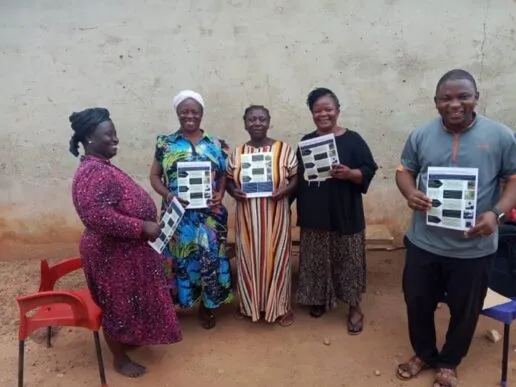
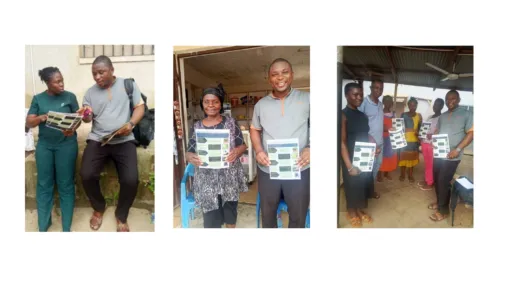
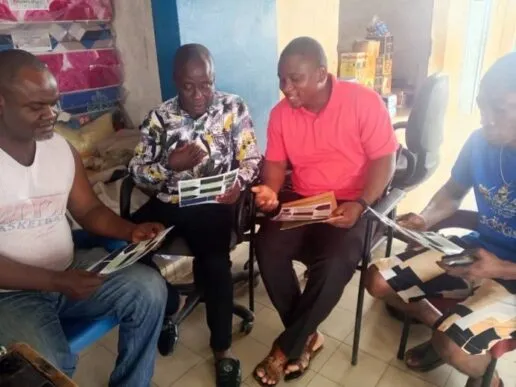
We have recently produced a dissemination document that was shared with the assembly people and leaders from the communities where research was undertaken. This was a crucial part of the process to ensure that the key findings derived from residents’ narratives were made available to those who granted us community entry. Governance structures surrounding urban nature in Ghana are complex; for example, intentionally planted trees remain the property of the landowner, whereas naturally growing trees are owned by the State. Therefore, it is essential for results to be disseminated at the local level, where community leaders are able to influence the behaviour of the communities.
The results highlighted the importance of informal, everyday nature – particularly due to the scarcity and access barriers to formal green spaces – and therefore, educating and encouraging local leaders is potentially an impactful strategy for promoting change. The feedback from the dissemination was positive; leaders promised to print further copies off to distribute around schools, they noted how the project has improved their understanding of the importance of nature, while one leader also promised to ensure tree planting was included within an upcoming road building exercise. While the impact may emerge over longer timescales or occur only at the local level, dissemination is vital not only from an ethical perspective but also for encouraging small changes that can improve the lives of often vulnerable communities.