By Alison Smith
Climate and nature are deeply interconnected, and we urgently need strategies that avoid conflicts and deliver benefits for both. So we were delighted when Oxfordshire’s Local Nature Partnership and District Councils asked us to help develop an integrated nature and carbon strategy as part of their Enabling Nature Based Carbon Sequestration project, funded by Innovate UK.
We aimed to assess the carbon sequestration potential of Oxfordshire’s Local Nature Recovery Strategy (LNRS), which was launched in November 2025 following two years of hard work and extensive consultations. The LNRS identifies opportunities to restore a wide range of habitats to support local species, including native woodlands, parkland with scattered trees, scrub, hedgerows, chalk grassland, floodplain meadows, wetlands, heathland and rewilded habitat mosaics.
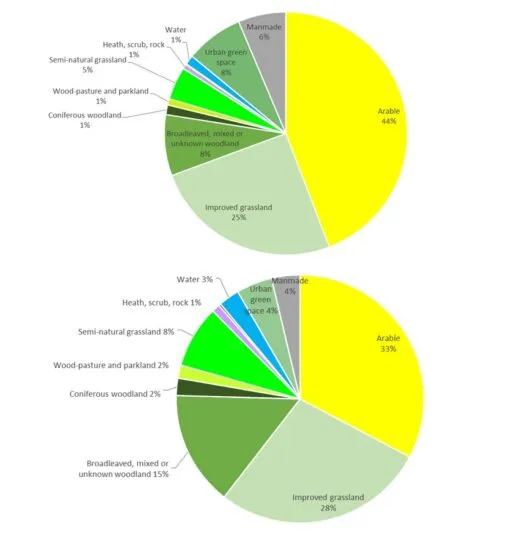
By combining the broad LNRS maps of ‘potential measures’ for nature recovery with our detailed Agile Nature Recovery Opportunity Map of Oxfordshire, we were able to develop scenarios that accounted for constraints such as buildings, roads, water, existing woodland and other priority habitats, and high-grade farmland (to avoid trade-offs with food production).
While a carbon-only strategy would have focused purely on tree-planting, we aimed to optimise carbon sequestration while creating a balanced mix of habitats in line with the LNRS priorities. Our strategy included restoration of woodland, grassland, wetlands, heathland and tree-grass-scrub mosaics, as well as an increase of 40% in hedgerow length, adoption of silvopasture and silvoarable agroforestry, and enhancing soil carbon on arable land.
The report shows that this strategy could increase carbon storage in Oxfordshire by up to 28% once habitats are mature and could offset 18%-20% of Oxfordshire’s current emissions over the next 30 years, of which 4%-7% of emissions are covered by existing market mechanisms such as Wilder Carbon and the Woodland Carbon Code. With good support from national and local policy mechanisms, alongside continuing efforts to drive down fossil fuel emissions, this strategy could deliver climate and nature targets alongside multiple additional benefits for climate change adaptation, human health and well-being and resilient food production.
