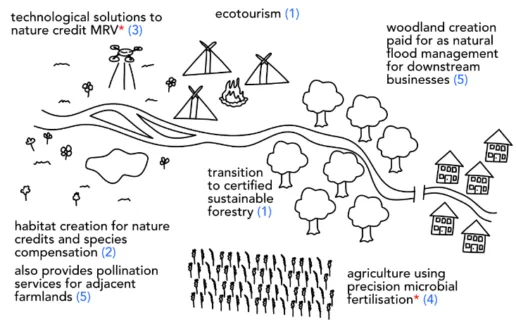
It feels like the central question of the nature finance, & business and biodiversity paradigm is: can you make money in a way that improves biodiversity?
Sophus zu Ermgassen
I spent the last 5 yrs on this, mostly from a critical perspective. In our new preprint, “Business Models for Biodiversity,” we’ve assembled some of the world’s best academics studying biodiversity business models (BBMs) that hope to improve biodv in different contexts. We have me, Alice Stuart & Mattia Troiano (nature markets), Florian Egli Katharina Wildgruber (pioneered study of tech innovations that address biodiversity threats), Helen Toxopeus Cătălina Papari (financing of urban NbS), Siddarth Shrikanth (nature investor), Jamie Batho (nature tech), Benjamin Thompson (biodiversity finance & entrepreneurship esp tourism), Susan de Witt (southern African wildlife economy), Charlotte Maddinson (organisational biodv footprinting).
We review five core BBMs:
- Selling regular commodities & aiming to generate biodiversity as co-benefit
- Commodifying nature itself & selling it as a credit
- Assist in biodiversity management, largely nature tech
- tech innovations for reducing biodiversity pressures (biodiversity-enhancing technologies and substitutes)
- nature that helps reduce risk exposure to adjacent assets.
We review everything we can about these BBMs: their biodiversity theory of change, financial characteristics & performance, & revenue models. All sorts of incredible information arose. eg private conservation hasn’t scaled in most places in the world but in South Africa 17% of the country’s land area is covered by private conservation businesses.
Then critically we look into the actual evidence from conservation science about whether or not these BBMs generate real biodiversity benefits. Across all of these business models we find recent review papers that basically show it’s always contextually specific whether or not they do. This is critical, because then we review the overall policy landscape which governs BBMs & find that it often uses simple typologies or classifications that say this type of model is good, this type of model is bad. That does not match up with the conservation science literature that shows intense context specificity of the benefit of businesses across each BBM.
Then we outline some of the fundamental limitations of having a profit-focused approach to conservation enterprise: much of the most socially valuable NbS work generates all sorts of societal benefits but will never be profitable enough attract private investment – re-emphasising the need to increase public investment in nature.
I’ve been particularly inspired here by Global Canopy‘s Little book of nature business (by John Tobin-de la Puente & Andrew Mitchell) which was IMO the first great effort to popularize the idea that there have been nature businesses all over the place if you know where to look.
Related Research Themes

Finance
Scaling finance and investment for rapid nature recovery at a global scale.
