EcoEvoRxiv (2026)
New pre print out now
To address global biodiversity declines, governments have committed to ambitious biodiversity-related international policy goals and targets. In parallel, there has been rapid growth in datasets and monitoring resources, which has collectively increased the capacity to track progress towards these global commitments. However, a clear overview of how resources map to these commitments is lacking, leaving monitoring gaps unidentified and limiting the effective use of existing resources for tracking and assessing progress.
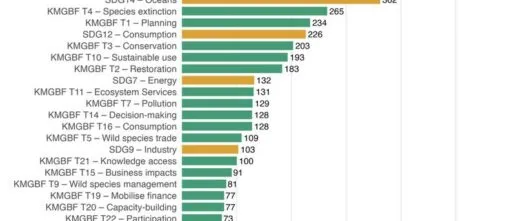
Here we assess coverage of the current monitoring landscape through an evidence map of the grey and scholarly literature, spanning international commitments represented by biodiversity-related goals and targets across the Global Biodiversity Framework (KMGBF), Sustainable Development Goals (SDGs), and Paris Agreement. We collate 1,008 resources, comprising 350 peer-reviewed papers and 658 other monitoring resources – including datasets, information platforms, trackers and reports – and map their relevance to 30 international commitments for biodiversity protection and recovery.
Our analysis reveals that a wealth of diverse monitoring resources exist to support progress tracking and inform decision-making towards global biodiversity-related commitments. All 30 commitments had relevant resources, indicating that a foundation for monitoring exists across all goals and targets. However, resource coverage was highly uneven, ranging from 17 to 554 resources for an individual commitment. Climate-related commitments were associated with the most monitoring resources, while commitments relating to biosafety, gender, incentive reform, and genetic resources were supported by substantially fewer resources.
This uneven distribution, together with varying resource accessibility, and limited standardisation and comparability, suggests disparities in monitoring capability for different policy areas. By presenting the current monitoring landscape in a structured format, our inventory provides a foundation for more effective use of existing resources to support ongoing global monitoring and reporting processes. Additionally, it enables practitioners to rapidly identify resources relevant to specific biodiversity-related commitments and guides future monitoring investment and action.