Nature is declining at an unprecedented rate, with continued loss of species, ecosystems, and the vital services they provide to people. This threatens climate resilience, food security, human wellbeing and sustainable development, highlighting the urgent need for more effective action.
Achieving global goals such as the Kunming-Montreal Global Biodiversity Framework, the Paris Agreement and the Sustainable Development Goals will require transformative action across governments, businesses, financial institutions and society. While existing initiatives provide valuable information on biodiversity status and progress, countries still face difficult decisions about where to focus limited resources to achieve the greatest impact.
Because countries differ in their biodiversity, economies, governance and capacity, there is no one-size-fits-all solution. There is a growing need for approaches that help identify nationally relevant priorities while recognising the interconnected nature of biodiversity loss and the cross-border impacts of national actions.
About the project
NATURE Impacts is a forward-looking approach that combines scientific evidence, existing datasets, modelling and local expertise to help countries identify and prioritise the actions that can make the greatest contribution to global nature recovery. The approach is tailored to each country’s ecological, social and economic context.
NATURE Impacts is designed to complement and build upon existing initiatives by taking a bottom-up, country-led approach. It supports governments, civil society and other stakeholders to make informed decisions about where action and investment can deliver the greatest benefits for nature and society.
Our approach
NATURE Impacts is built around four key principles:
- Grounded in local knowledge – Priorities are shaped by local expertise, including governments, researchers, Indigenous Peoples and local communities, NGOs, businesses and other stakeholders.
- Building on existing evidence – The approach integrates existing biodiversity datasets and scientific evidence while incorporating expert knowledge to address important information gaps.
- Recognising international impacts – National actions can have positive and negative impacts beyond borders. The framework considers these wider effects to help identify actions that maximise global biodiversity outcomes.
- Connecting nature, climate and people – The approach recognises the close links between biodiversity, climate change and human wellbeing, identifying opportunities that maximise co-benefits while acknowledging potential trade-offs.
Current activities
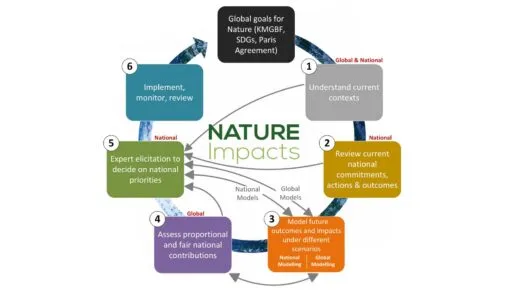
NATURE Impacts is developing and testing the approach through a series of interconnected steps that together support evidence-based national priority setting.
- Understanding national contexts
Bringing together ecological, social and economic evidence to understand each country’s current context, biodiversity status and key pressures. - Assessing current action
Reviewing existing commitments, policies, actions and outcomes to understand current progress and identify opportunities for greater impact. - Exploring future scenarios
Using models to examine how different policy and management options could influence future biodiversity outcomes. - Considering fair national contributions
Exploring how different approaches to sharing responsibility between countries influence the level of effort each nation may need to make towards achieving the KMGBF goals. - Identifying national priorities
Working with in-country experts and stakeholders to combine evidence, local knowledge and diverse perspectives to identify the most impactful national priorities. - Monitoring and refining priorities
Supporting an iterative process where priorities are reviewed, modelled and updated as new evidence, data and progress become available.
Long-term vision
As NATURE Impacts develops, we aim to create practical tools that help countries identify and prioritise the actions most likely to contribute to halting and reversing biodiversity loss.
These include:
- an interactive platform providing country-level information on biodiversity, commitments, current actions and priority opportunities;
- country opportunity reports highlighting the highest-impact actions for nature; and
- regular global syntheses that share emerging priorities and inform international biodiversity policy.
Together, these outputs will help support more coordinated, evidence-based and locally informed action, enabling countries to make the greatest possible contribution to global biodiversity recovery.


Related Outputs
Partners

